

AI Search Attribution Is Breaking: Why ChatGPT Ads and AI Overviews Are Wrecking Your Reports
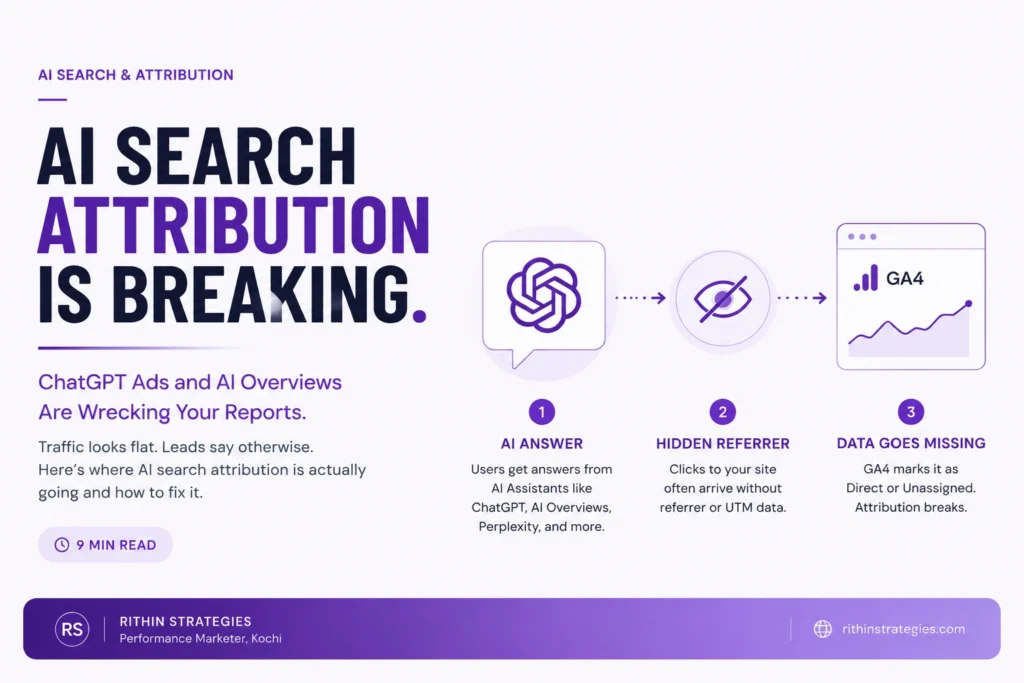
Performance Marketing · Attribution & Measurement AI Search Attribution Is Breaking: Why ChatGPT Ads and AI Overviews Are Wrecking Your Reports Your GA4 dashboard says traffic is flat. Your leads say otherwise. Here’s where AI search attribution is actually going and six ways to fix it. Rithin P V · Performance Marketer, Kochi · 9 min read A client messaged me last month convinced their ad account was broken. Leads were coming in steady, sometimes faster than usual, but GA4 showed almost no source for them. No campaign, no referrer, just “Direct” and “Unassigned” piling up in the reports. Nothing was broken. What they were looking at was AI search attribution quietly falling apart because ChatGPT ads, AI Overviews, and tools like Perplexity and Copilot don’t hand off the clean referral data that Google Analytics was built around. If you’re running paid or organic campaigns in 2026, this isn’t a future problem. It’s already sitting in your reports today, disguised as a data quality issue instead of what it actually is: a structural shift in how people research and click. IN THIS ARTICLE 1. What actually changed in AI search attribution 2. Why ChatGPT ads and AI Overviews break your attribution model 3. How to spot AI search traffic hiding in your GA4 reports 4. 6 fixes to rebuild attribution for the AI search era 5. FAQ What Actually Changed in AI Search Attribution Attribution has always meant tracing a sale back to the marketing that caused it. That job got harder every year as journeys spread across more devices and channels, but the basic mechanics stayed the same: a click carried a referrer, a UTM tag, or a click ID, and your analytics tool used that string to assign credit. AI search breaks that mechanic at the source. When someone asks ChatGPT to compare CRM tools, or asks Google’s AI Overview to summarize the best accounting software for a small business, the answer gets generated and shown right there. If the user clicks through to your site from that answer, the click often arrives stripped of the referral data your analytics setup expects. Google Analytics has nowhere to put it, so it defaults to “Direct” or “Unassigned,” the two buckets that tell you almost nothing about what actually influenced the visit. Layer paid ads on top of that. ChatGPT rolled out its own advertising surface in 2025, and Google’s AI Mode is carrying ads inside AI-generated answers rather than beside them. Both are genuinely new inventory, and neither passes data through your ad platform’s conversion tracking the way a normal Google Search or Meta ad does. You’re spending in a channel your existing attribution model was never built to see. Why ChatGPT Ads and AI Overviews Are Breaking Your Attribution Model The dark traffic problem Marketers call this “dark traffic,” and it’s not new, exactly, it’s just gotten much bigger. Dark traffic is any visit your analytics can’t confidently trace to a source: app-based browsers, copied-and-pasted links, and now AI-generated answers. A visitor who reads a ChatGPT summary, opens your site in a new tab, and buys three days later shows up in GA4 as a cold, sourceless conversion. The AI conversation that actually drove the decision never gets credit. WHY THIS MATTERS If AI-influenced visits keep landing in “Direct,” your reports will make organic and paid AI search look like it’s doing nothing, right up until you cut the content or campaign feeding it and your direct traffic drops with it. ChatGPT ads don’t pass referral data the way you expect ChatGPT’s ad units sit inside a conversational answer, not a results page, so there’s no guarantee the click carries a standard UTM string unless you’ve built the landing page to expect one. I’ve seen agencies assume their existing Google Ads tracking template would “just work” on ChatGPT campaigns. It doesn’t, not without manually appending parameters and testing that they survive the click. Zero-click answers are eating your top-of-funnel data A lot of AI search traffic never becomes traffic at all. The person gets their answer inside ChatGPT or the AI Overview and never visits your site, even though your content or your brand shaped the answer they read. That’s real influence with zero footprint in any analytics tool, which is why relying on click-based attribution alone will systematically undercount everything AI search is doing for you How to find AI Search traffic in your GA4 reports Before fixing anything, confirm how much of your “Direct” and “Unassigned” traffic is actually AI-influenced. Three checks catch most of it: Where to look What you're checking for GA4 → Traffic acquisition Spikes in Direct/Unassigned that line up with new content publishing, not seasonality Landing page report + engagement time Direct sessions landing on deep, specific pages instead of the homepage — a strong AI-referral tell Conversion path length Conversions with unusually short paths and no prior recorded touchpoint at all None of this proves a visit came from ChatGPT specifically, but a pattern of direct traffic hitting deep, narrow pages with decent engagement time is a strong signal that an AI assistant sent them there, not that they typed your URL from memory. 6 Fixes: How to Rebuild Attribution for the AI Search Era None of these fixes bring back perfect, click-level attribution. That version of measurement is fading everywhere, not just in AI search. What they do is give you enough signal to make real budget decisions instead of guessing. 1. Tag everything, including links that feel unnecessary Put UTM parameters on every outbound link you control: newsletter mentions, PR placements, ChatGPT ad landing pages, even links in downloadable PDFs. You can’t tag a link inside an AI assistant’s generated answer, but you can make sure every link you do control leaves a trail, so what’s left unattributed shrinks. 2. Move critical conversions to server-side tracking Browser-based tracking is the first thing AI assistants, privacy browsers, and iOS strip out. Server-side tagging and conversion APIs (Meta CAPI, Google